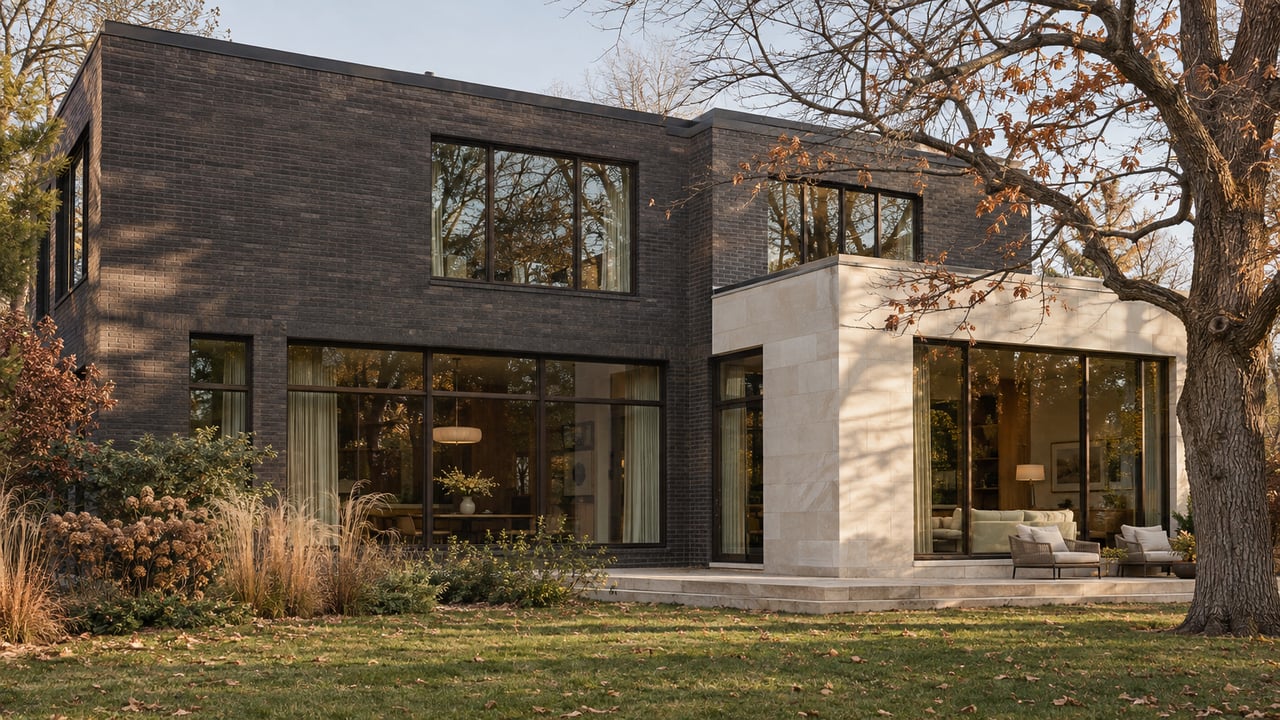
What is a Hilltop lot worth when the house a builder can put on it gets smaller? According to the city's building form display board, Denver's current rules allow unlimited floor area on residential lots. The city's November 2026 Unlocking Housing Choices materials propose changing that. They would cap the above-grade livable area of any new single-unit home based on lot size, while existing homes larger than the cap "could be rebuilt or remodeled" at their current size.
That second clause matters more in Hilltop than almost anywhere else in Denver. If the cap is adopted, the large homes already built here become a fixed supply that new construction can't add to. The value that now sits in a buildable lot would start shifting toward square footage that already exists.
The Price a Hilltop Rebuild Has to Clear
Builders price a teardown by working backward from the sale price of the finished house. In August 2026 the city released a financial feasibility study by Root Policy Research. It names Hilltop directly. Typical Hilltop parcels are valued at more than $1 million, and a single-unit redevelopment here has to sell for more than $3 million to justify the project.
That math has held up for years. The same study counts Hilltop among seven neighborhoods that together accounted for 60% of Denver's cases where a single-unit home was replaced by a larger one between 2010 and April 2025. In those neighborhoods, between 6% and 14% of single-unit homes were replaced this way. Hilltop's own count for that period was 176 replacements.
The $3 million figure depends on a large house. A builder paying more than $1 million for a lot needs enough square footage to sell, and the proposal limits that square footage.
The Proposed Ceiling, Lot by Lot
Most of Hilltop is zoned Urban Edge single-unit, mainly E-SU-D, E-SU-Dx and E-SU-G. Lots here commonly run from about 6,600 to 10,000 square feet. On the city's zone descriptions page, "E" means Urban Edge, "SU" means single unit, and the final letter refers to a lot size standard: "D" is 6,000 square feet and "G" is 9,000. Your parcel's zoning is listed on the city zoning map.
Here is the proposed maximum above-grade livable area from the November 2026 meeting presentation, for the lot sizes that cover most of Hilltop:
| Lot size | 1 unit | 2 units | 3 units | 4+ units |
|---|---|---|---|---|
| 5,001–7,000 sq ft | 3,500 | 4,500 | 5,000 | 5,500 |
| 7,001–10,000 sq ft | 4,000 | 5,000 | 5,500 | 6,000 |
| 10,001–15,000 sq ft | 4,500 | 5,500 | 6,000 | 6,500 |
| Over 15,000 sq ft | 5,000 | 6,000 | 6,500 | 7,000 |
The city describes the purpose plainly. The limits are meant to incentivize "more units per lot, rather than very large single unit homes" and to slow speculative redevelopment. The building form board also proposes requiring any third story to sit under a pitched roof. Two-story flat-roof homes would still be allowed.
Where Recent New Homes Fall Against That Line
The feasibility study reports that new single-unit homes built in Denver's Urban Edge areas between 2019 and April 2025 averaged 4,766 square feet, with an average appraised value of $2.322 million. Hilltop is part of the Urban Edge. More than three in four of those homes replaced smaller existing houses. The city's June 2025 Issue Identification Report looked at 2024 demolition and rebuild records citywide. The original homes averaged 1,299 square feet and their replacements averaged 4,405.
Those averages sit right around the 4,000-square-foot cap for a single home on a 7,001 to 10,000 square foot lot. The cap counts only above-grade space, though. The city's own display board notes that finished basements are "very common in new construction." A future Hilltop rebuild would likely keep its size by going down rather than up. That changes how the house is laid out and what a buyer is paying for at the top of the market.
Three Kinds of Property, Three Different Outcomes
If the proposal is adopted as written, the same rule affects each kind of Hilltop property differently:
- The teardown lot. A builder's largest possible single-family product on that lot gets smaller. The study says size limits reduce developer returns below current thresholds but generally leave them positive. In Hilltop, where the land alone costs more than $1 million, a lower return comes straight out of what a builder can offer for the lot.
- The large home already standing. Existing homes above the allowance could be rebuilt or remodeled up to their current size. Additions would be limited. Any home built before the cap took effect would keep square footage that new construction on a similar lot could no longer match above grade.
- The modest original house. Under the retention bonus, an owner who keeps the existing home could add more primary homes alongside it, up to four in Urban Edge areas, and those homes could be sold or rented on separate parcels. The cap also increases with unit count, reaching 6,000 square feet for four or more units on a 7,001 to 10,000 square foot lot.
The first and third items push in opposite directions. The open question is whether added units can make up for what the cap takes away from the single big house.
Why the City Expects Hilltop to Keep Building Single Homes
The city's consultant doesn't expect Hilltop to switch to duplexes. It groups Hilltop with Belcaro, Cory-Merrill, Washington Park and University/University Park, neighborhoods where demand for larger homes remains strong. In those neighborhoods it projects an average of 12 single-unit homes replaced by larger single-unit homes each year, compared with 2 converted to missing middle housing.
Land cost is the reason. The study's Urban Edge models assume average land costs of $550,000 to $866,400 on an 8,125-square-foot lot. Typical Hilltop parcels are above $1 million. At those modeled land costs, a 4,000-square-foot new single home and an ownership triplex both cleared a 15% return on cost. Rental plexes fell short, with financing gaps of $625,000 and $650,000. Hilltop land costs more than any of the modeled cases, so a single large home stays the most likely use of a Hilltop lot, and that is the product the cap shrinks.
Put together, the proposal leaves Hilltop's redevelopment pattern in place and caps its largest version. New homes would still go up, but they would be smaller above grade than the ones already here.
A Proposal That Has Already Changed Once
This is not settled policy. In September, Denverite reported that the city had postponed its plan to limit new home sizes and narrowed the density changes to properties within a quarter-mile of transit priority streets and rail stations. City planner Rob Elsasser explained the shift in Denverite's coverage this way:
"Ultimately our charge is to bring something forward that we can get adopted."
The November materials bring the floor-area table back. They describe the changes as applying to areas with single-unit and two-unit zoning, with no transit-distance condition. The city's tentative schedule calls for amendment drafting through December, a Planning Board hearing in January or February 2027, and City Council committee review and a Council decision in March 2027. Two public meetings remain in the November series. The first is Wednesday, Nov. 18, at Barnum Recreation Center, 360 Hooker St. The second is Thursday, Nov. 19, at Harvard Gulch Recreation Center, 550 E Iliff Ave. Both run from 5:30 to 7:30 p.m.
The Hilltop Neighborhood Association's July 2026 newsletter said the association was reviewing the proposal ahead of the Council vote. It listed infrastructure, drainage, tree canopy, parking and traffic among the concerns it was examining.
The Market the Rule Would Arrive In
The proposal comes as the high end of the metro market is slowing. In its October 2026 Market Trends Report, released Nov. 4, the Denver Metro Association of Realtors reported that $1 million-plus closings fell 24.05% year over year in October and sales volume dropped 26.04% to $656 million. Homes that did sell went under contract faster, at a median of 17 days compared with 34 in October 2025. Year to date through October, $1 million-plus sellers received 98.27% of list price, and DMAR said detached homes were "carrying the segment."
For a Hilltop seller, a buyer looking for space and a builder pricing land, the next few months combine fewer closings with a zoning decision expected in March. Large finished homes would keep their size whatever Council decides. Teardown lots are the property type whose value depends on the vote.
A Few Specific Questions
Would the cap shrink an existing Hilltop home?
No. The city's materials say the change does not affect existing homes. Homes over the allowance could be rebuilt or remodeled up to their current size, though additions would be limited.
Does a finished basement count toward the limit?
The cap is written as maximum above-grade livable area. How the final code language treats lower levels will be settled during drafting.
How many homes could the retention bonus allow?
Up to four primary homes per lot in Urban Edge areas like Hilltop, including the retained house.
This post is general information about a pending zoning proposal, not legal, tax or financial advice. Before acting on a specific lot or home, confirm how the rules apply to your parcel with a land use attorney, architect or the city.
If you own a Hilltop home, are weighing an offer from a builder, or are deciding between a finished new build and a lot to build on before Council votes in March, Nick Bruce can go through the lot size, zoning and comparable sales on your address with you. Schedule a consultation.